
Electric Awnings for Kansas City Patios: Wiring, Motors, and Remotes
Awnings — July 17, 2026
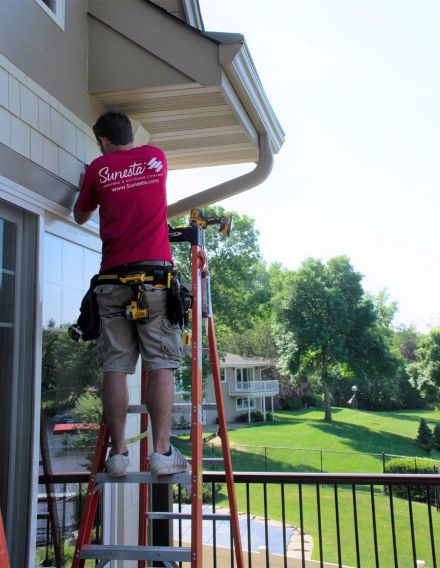
How powered retractable awnings actually work: hardwired vs. plug-in, the Somfy motor and RTS remote, phone and hub control, and the automatic wind sensor that retracts before a KC gust front does the deciding for you.
What an electric awning is (and is not)
An electric awning is a retractable awning driven by a motor tucked inside the roller tube instead of a hand crank. Press a button and the arms extend or fold; the fabric rolls out and back on its own. Everything else about the awning is the same as a manual unit. On our Sunesta, Sunstyle, and Sunlight models, you still get the dual-cable arm system that carries up to 14'8" of projection with no front posts, widths up to 40', and 130+ Sunbrella-grade fabric options. Power changes how you operate the awning, not what it can span or how it mounts.
What this guide covers
We want to be clear about the boundary of this guide. This is the power-and-control side of the decision: how the motor is wired, how you run it, and what the automation does. If you are still weighing whether to go powered at all, that is a separate question with its own trade-offs, and we cover it elsewhere.
Electric awning wiring: hardwired vs. plug-in
Every powered Sunesta awning we install uses a Somfy motor rated for standard 120V household current. You have two ways to feed it. A plug-in setup runs a cord to a nearby weatherproof GFCI outlet, which is the simplest path when an exterior outlet already sits within a few feet of the mount. A hardwired setup routes the motor lead through the wall to a switched circuit or a junction box, which hides the cord entirely and is what most homeowners choose for a finished look.
Who handles the electrical connection
Hardwiring means a licensed electrician taps into a circuit, not us. We set the awning, land the motor, and coordinate the drop location; the electrical connection to the home's panel is licensed electrical work. On new construction or a remodel, we tell your builder where to stub out power before the awning ships. On an existing patio, plan on the electrician's visit as a separate line item unless a serviceable exterior outlet is already there.
The Somfy motor and RTS remote
The motor pairs with a Somfy RTS handheld remote, the same radio-control platform we use on our Sentry motorized solar screens. RTS is a one-way radio signal, so the remote does not need line of sight and works from inside the house through a wall. One remote can hold multiple channels, which matters when you run more than one awning or want to control an awning and a screen from the same device. Wall-mounted RTS switches are available too, for a fixed control point by the patio door.
Preset limits mean repeatable operation
Because the motor stops at set limits, the awning extends to the same projection every time and folds back to the same closed position against the SmartCase cassette. No overrunning the arms, no eyeballing where to stop the crank. Those limits are set during install and hold until you change them.
Can you control an electric awning with your phone?
Yes, with the Somfy TaHoma hub. TaHoma bridges the RTS awning to your home Wi-Fi so you can open, close, and set schedules from the Somfy app on a phone or tablet. It also ties the awning into voice assistants and lets you group the awning with other Somfy-driven shades or screens into scenes. If you travel and want to retract a canopy remotely before a storm rolls through, or extend it before you get home on a hot afternoon, the hub is what makes that possible.
App control is optional
App control is an add-on, not a requirement. Plenty of homeowners run their awning entirely on the RTS remote and never touch a phone. The hub earns its place when you want scheduling, remote access, or one control surface for several powered products.
The wind sensor is the reason to go powered
The most useful upgrade on a powered awning is the automatic wind sensor. Retractable awnings are shade structures, not storm structures. Left extended in a Kansas City spring gust front, the fabric acts like a sail and the arms take load they were never meant to hold open. The wind sensor watches for that and retracts the awning on its own, so the awning is safe even when you are not home to bring it in.
Retract thresholds across the KC metro
We set the metro-standard retract threshold at 28 mph. On bluff-edge sites above the Missouri River, in Parkville and along the north-of-the-river bluffs, we drop that threshold to 22 mph because the wind loads up faster over the edge. This is not a number to guess at. KC gets 50+ mph gusts most springs, and the sensor is what keeps a custom awning from becoming a kite when a front comes through on a Tuesday while you are at work.
Do you need an electrician? A straight answer
Don't hire a separate electrician if a weatherproof exterior GFCI outlet already sits within a few feet of where the awning mounts. In that case a plug-in motor is the whole job and we handle it during install. You only need an electrician when you want the cord hidden in the wall or there is no serviceable outlet nearby. Sort that out during your in-home measure so there are no surprises, because the electrical trade is the one part of a powered awning we do not self-perform.
Older KC homes vs. newer Johnson County stock
A note for older KC housing stock: pre-1970 homes in Brookside and Hyde Park often have limited exterior outlets and older service, so the electrician's scope can be larger than expected. Newer Johnson County homes in Overland Park, Olathe, and Leawood usually have exterior GFCI outlets already stubbed near patios, which frequently makes a plug-in setup the clean answer.
Permits, mounting, and the install itself
Powering the awning does not change how it attaches to your home, and the substrate still drives the mount. We through-bolt to the band joist with backing plates on framed walls, use wedge anchors into solid brick courses on masonry, and never anchor into fascia or mortar joints. For awnings over 30 square feet on wood-frame second stories, the City of Kansas City, MO Codes Administration reviews the structural attachment, and the added motor does not exempt that. In ARB-reviewed neighborhoods like Mission Hills and Sunset Hill, the fabric and frame color still go through the same architectural review whether the awning is powered or not.
Lead time and scheduling the electrician
Lead time from order to installation runs four to six weeks, the same as any Sunesta unit, because each awning is custom-built in Jacksonville, Florida and installed by our in-house Sunesta-Certified Installers. If a hardwire is part of the plan, we recommend booking the electrician for the week of install so power is ready when the awning goes up.
Making the call
A powered awning is the difference between shade you have to go crank and shade that answers a button, a phone, and a wind gust on its own. The motor and remote handle the day-to-day; the hub adds your phone and a schedule; the wind sensor handles the weather you cannot plan for. If you already have an exterior outlet, the whole thing is often plug-and-play. If you want it wired clean, plan the electrician into the timeline. Either way, we measure, fabricate, and install the awning, and we will map the power on the same visit we measure the opening.