
Motorized vs. Manual Retractable Awning: Which Is Right for a Kansas City Deck
Awnings — June 19, 2026
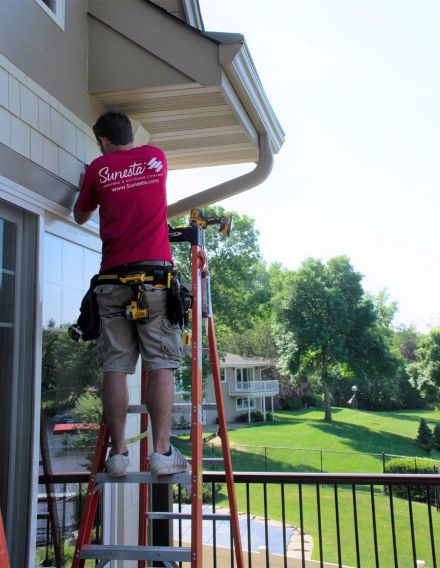
The real deciding factor isn't price. It's how exposed your deck is to KC's 50+ mph spring gusts. Here's an honest comparison so you pick the right awning the first time.
Most comparisons of motorized versus manual awnings come down to one line: motorized costs more, manual is cheaper, pick your budget. That framing is wrong for the Kansas City metro, and following it is how people end up with the wrong awning. The deciding factor here isn't price. It's exposure. How big is the awning, which way does the deck face, and how hard does the wind hit it. Once you answer those three questions honestly, the right choice usually picks itself.
We measure, fabricate, and install Sunesta retractable awnings across the metro, and the single most reliable predictor of which mechanism a homeowner should run is the deck's exposure to spring gust fronts and 4 p.m. west sun. So that is where this comparison starts.
Motorized vs. manual retractable awning: the short version
A manual Sunesta uses a hand crank to extend and retract the dual-cable arm system. A motorized Sunesta runs on a Somfy Sonesse tubular motor, operated from a Somfy Telis 4 RTS remote or, if you add it, the TaHoma hub from your phone. Both use the same fabric, the same arms, the same frame, and the same 130+ solution-dyed acrylic fabric options. The mechanism is the only real difference.
The practical split looks like this. Manual is the right call for a small, sheltered patio, where the awning is narrow, you extend it a few times a week, and there is no easy way to run power. Motorized is the right call for anything wide, anything west-facing, and anything on a Missouri River bluff edge, because those decks need a wind sensor, and a wind sensor only works on a motorized unit.
When a manual retractable awning is the better choice
Do not let anyone strawman the manual awning. For the right deck it is the smarter buy, and we install plenty of them.
Manual makes sense when:
- The awning is on the smaller side, the kind of span you can hand-crank in well under a minute.
- The deck is sheltered. A small mid-century patio off the back of a Prairie Village ranch, tucked between the house and a fence line, does not see the same gust load as an open second-story deck.
- There is no simple power run nearby, and you would rather not pay to bring a circuit out to the awning.
- You want the lowest cost of entry. With no motor and no automation, the manual unit is the least expensive way into a true Sunesta awning.
The honest tradeoff is that you are the wind sensor. You have to be home, you have to notice the sky turning, and you have to go out and crank the awning in before a gust front arrives. On a sheltered patio that you only extend when you are sitting under it anyway, that is a non-issue. You can compare the three Sunesta awning models on our retractable awnings page to see which width and projection fits a smaller patio.
When motorized is the better choice
Motorized earns its keep on exposed decks, and most KC decks are more exposed than people think. Here is what tips the decision.
The span. Sunesta awnings go up to 40 feet wide with up to 14'8" of projection on the dual-cable arm system, with no front posts. Once you are past a certain size, hand-cranking stops being charming and starts being a chore, and you simply stop using the awning. A motor removes that friction entirely.
The orientation. West-facing decks across Jackson, Clay, Platte, and Cass County get hammered by low-angle sun between 3 p.m. and 6 p.m. in summer. That is exactly when you want the awning out, and exactly when nobody wants to walk outside into 95-degree heat and 70 percent humidity to crank it. A Telis remote, or a scheduled extension through TaHoma, puts the shade out before you sit down.
Why the wind sensor decides it for most KC decks
This is the part generic comparison articles miss completely, because they are not written for this metro. Kansas City gets spring gust fronts of 50-plus mph. A retractable awning is a shade device, not a storm structure, and the correct response to a 50 mph gust is to be retracted before it hits.
A wind sensor does that automatically. Our metro-standard retract threshold is 28 mph, and the sensor pulls the awning in on its own the moment wind crosses that line, whether you are home or not. For bluff-edge sites above the Missouri River, in Parkville and the KC bluffs, we set a lower 22 mph threshold because the wind comes off the bluff harder and faster.
Here is the catch. A wind sensor is automatic retraction, and automatic retraction requires a motor. You cannot bolt a wind sensor onto a hand crank. So if your deck is exposed enough to need automatic wind protection, and most west-facing and bluff-edge KC decks are, the decision is already made. You need motorized, not because motorized is fancier, but because the wind sensor is the feature that actually protects the fabric and the arms over years of KC springs.
We set Somfy Sonesse motors with the wind sensor pre-configured to your site's threshold during the install, and you can see our Somfy-motorized awning options for the motor, remote, and TaHoma details.
So which one should you buy
If your patio is small, sheltered, and you are happy to crank it yourself, buy the manual and save the money. If your deck is wide, faces west, or sits on a bluff edge, buy motorized and add the wind sensor. That is not an upsell, it is the difference between an awning that survives a decade of KC weather and one that gets damaged on the first bad spring.
Every Sunesta is custom-built in Jacksonville, Florida and installed by Sunesta-Certified Installers, with a four to six week lead time from order to installation. The fastest way to settle the motorized-versus-manual question for your specific deck is to have us measure it. We look at the width, the orientation, the substrate we are anchoring into, and the wind exposure, then tell you straight which mechanism fits. Call us at 913-355-1236 or request a free in-home consultation to get a measure on the calendar.