
Retractable Awning vs. Pergola: Which Shades a KC Deck Better?
Awnings — July 10, 2026
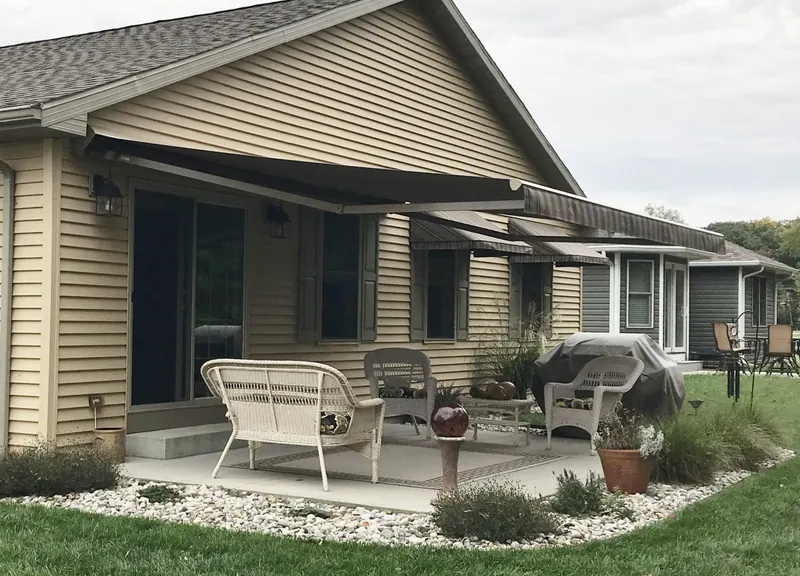
A pergola is a permanent structure you never operate. A retractable awning is sun when you want it and shade when you need it. Here's how the two compare on a Kansas City deck, including how each handles our 50+ mph spring gusts.
You've got a west-facing deck that turns into a furnace by 4 p.m., and you're weighing two ways to fix it: build a pergola, or install a retractable awning. They solve the same problem, but they solve it in opposite ways. A pergola is a permanent structure that lives on your deck year-round. A retractable awning gives you sun when you want it and shade when you need it, then rolls away. Which one is right comes down to how you actually use the deck across a Kansas City year, not just how it looks in a July catalog photo.
Retractable awning vs. pergola: the core difference
A pergola is fixed. Posts sink into footings, the frame stays put, and whatever shade its slats throw is the shade you get every day of the year, including a 45-degree February afternoon when you'd rather have the sun. A retractable awning is the opposite: a dual-cable arm system extends a solid fabric roof out over the deck on the days you want it, then retracts flat against the house the rest of the time. That single mechanical difference drives almost every trade-off below. One is architecture you commit to; the other is shade you operate.
Shade control across a KC year
Kansas City doesn't have one climate, it has four, and they each want something different from your deck. Summer runs near 95 degrees with roughly 70% humidity for weeks at a stretch, so you want a solid, full-coverage roof over the deck for those months. Come October, that same roof is blocking the low, warm sun you actually want to sit in. A pergola can't tell the difference between the two seasons. A retractable awning can: you extend the fabric for the August heat and pull it back for shoulder-season sun. On a west-facing deck, the practical test is projection at 4 p.m., when the low sun is worst, and a Sunesta reaches up to 14'8" out with no front posts to work around.
Which is better for wind: awning or pergola?
This is where a lot of KC homeowners get the decision wrong. Spring gust fronts here routinely hit 50+ mph, and a fixed pergola simply takes that load standing still, which is fine if its footings and connections were engineered for it. A retractable awning handles wind differently: it gets out of the way. Our units carry a wind sensor that auto-retracts the fabric at 28 mph across most of the metro, and at a lower 22 mph threshold on bluff-edge sites above the Missouri River in areas like Parkville. So the awning isn't fighting the gust front, it's stowing before the gust front becomes a problem. A pergola is only as wind-safe as its structural attachment; an awning removes its own sail area automatically.
!img https://pqprfqxcvwkxugcucueh.supabase.co/storage/v1/object/public/fabrics/2021/03/IMG_7603.webp A Sunesta retractable awning fully extended over a shaded Kansas City deck on a hot afternoon
Permits, footprint, and your home's structure
A pergola is a permanent structure, which means footings, a foundation footprint on your property, and in many cases a building permit. A retractable awning attaches to the house band joist and carries no ground footprint at all. On the KC side, awnings over 30 square feet on wood-frame second stories go through Kansas City, Missouri Codes Administration for structural attachment review, and ARB-reviewed neighborhoods like Mission Hills and Sunset Hill weigh in on anything visible from the street. But the mounting reality is usually simpler than a footing dig. We through-bolt to the band joist with backing plates on pre-1970 homes with cedar fascia, core 1/2-inch pilot holes for stucco-on-frame in Hyde Park and the Country Club Plaza, and set 3/8-inch wedge anchors into solid brick courses, never mortar joints. No concrete, no post holes, no permanent change to your deck's layout.
When a pergola is the better call
We'll be straight with you: a retractable awning isn't the right answer for every deck. A pergola is genuinely the better fit in three cases:
- If you want a permanent architectural feature that you never operate, that anchors climbing plants or a hanging light rig, and that reads as part of the house's built structure.
- If you need a freestanding shade structure out in the yard away from any wall to mount to, since a retractable needs a header to attach to.
- If your dream is dappled light filtering through slats rather than full solid-roof shade, that's a pergola look, not an awning look.
Buy the awning for flexibility and clean sightlines; buy the pergola for permanence and structure.
You can have both
The two products aren't mutually exclusive. If you already have a pergola that throws partial shade but still bakes under low-angle summer sun, a retractable awning or a Sentry motorized screen can be added to the existing structure to close the gap. We cover that pairing in detail on our pergola page at /pergola-awning-kansas-city, and the full mechanics of how the awning itself handles KC wind and sun live on /retractable-awnings. If you're still deciding, the honest way to settle it is to have us measure the deck and read the actual sun angles, not guess from a screen. Every Sunesta is custom-built in Jacksonville, Florida with a four to six week lead time, so there's no rushing the measurement.
Talk it through with our team
We measure, fabricate, and install with in-house Sunesta-Certified Installers, and the consultation is free with no obligation. Call 913-355-1236 or request a quote online, and Jeff's team will bring physical fabric swatches and read your deck's exposure before you commit to anything.