
Retractable Porch Awnings in Kansas City
You want your porch usable in July again, and a retractable awning is the flexible way to get there: shade on a 95°F afternoon, open sky in October. Here is the part most porch-awning articles miss. A porch is not an open deck. It already has a roof and posts, so the real question is whether you are shading the open side of the porch or the west sun that cuts in under the existing overhang, and that changes the whole spec. We measure the porch geometry first, then build a Sunesta unit custom to the inch in the U.S.A. and install it with our own Sunesta-Certified Installers, never subcontractors. Call 913-355-1236 for a free on-site measure.
What a Retractable Porch Awning Actually Does
A retractable porch awning is a motorized fabric cover on a dual-cable arm system that projects out past the porch roofline, then folds back flush against the house when you want the porch open. On a covered porch, it extends the shaded footprint past the existing overhang so the open sunny edge of the porch becomes usable. On a front porch with a low roof, it more often mounts as a fabric extension off the porch fascia to throw shade over the steps and the west-facing entry. Sunesta pioneered this arm engineering in 1981, and the dual-cable design is what lets a single unit reach up to 14'8" of projection with no front posts planted in the middle of your porch floor. After measuring porches across the KC metro, we've found the sun that ruins a covered porch almost always comes in low from the west after 4 p.m., under the existing roof, so a top awning alone won't stop it. That is why porch jobs so often pair a retractable awning on the open side with a SmartDrop or Sentry screen on the west edge. The porch already gives you a roof, so on most covered-porch jobs the awning is doing one specific thing: shading the open edge the roof doesn't reach. We size projection to that edge, not to the whole porch.
Retractable Porch Awning Sizing: Front Porch vs. Back Porch
Front porches and back porches get shaded differently, and copying one spec onto the other is the most common mistake we correct. A front porch is usually narrow, roofed, and set close to the street, so the job is a shorter-projection awning off the fascia to shade the steps and the entry from low west or east sun. A back porch is wider and more open, often stepping down to a deck, so it takes a wider awning at deeper projection to cover a full seating area. Projection matters more than width on a porch: a 16-foot unit at 11'6" of projection shades more usable floor than a 22-foot unit at 8'. We spec projection at 4 p.m. first, then go as wide as the porch wall allows, because on a porch the wasted width is worse than on a deck when you're already working around posts and a roofline. Since the dual-cable arms carry the full projection off the wall, the porch floor stays clear whether you have a 10-foot front porch or a 40-foot span across the back of the house. We measure the shadow path on site, note where the existing roof already shades, and cover only the strip that needs it.
- The Sunesta Model — Our heaviest-duty unit for wide back porches and porch-to-deck spans. Widths up to 40' and a maximum projection of 14'8" with no support legs on the front. Best where the porch opens onto a wide west-facing yard on the Missouri side.
- The Sunstyle Model — Our most popular porch choice. Widths up to 40' and 11'6" projection, with a sleek profile that fits around porch posts, sliding doors, and windows. Roof-mountable on low-clearance porches off Wornall where the fascia is tight.
- The Sunlight Model — For narrow front porches and mid-century ranch porches in Mission and Prairie Village. Widths up to 24' and 10' projection. An economical, custom-to-the-inch option for shading steps and an entry.
How Wide Can a Porch Awning Be Without Front Posts?
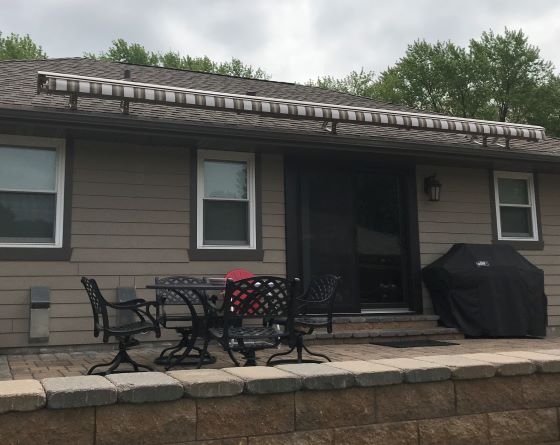
Up to 40 feet. That is the point of the Sunesta dual-cable arm system: it carries the full width and up to 14'8" of projection off the house wall with nothing touching the porch floor in front. Traditional post-supported awnings and pergolas plant legs at the front edge, which on a porch means posts in your walking path and around your furniture. Our arms replace those posts with four heavy-duty PVC-protected cables per arm, so a 40-foot porch span stays completely open underneath. On a porch the no-posts detail matters more than on a deck, because a porch is already a tight, framed space and you don't want to weave around legs to reach the steps.
Porch Awning Fabric Built for KC Humidity and Pollen
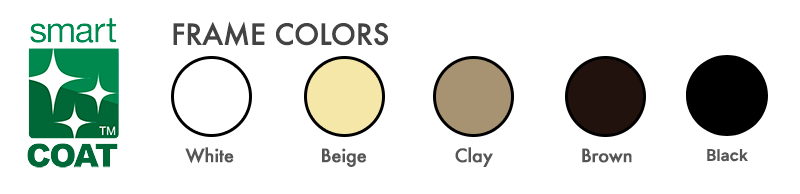
A covered porch traps still, humid air, and KC summers hold highs near 95°F with roughly 70% relative humidity for weeks, so the wrong fabric mildews and stains fast. We use solution-dyed acrylic, the same Sunbrella-grade material on every Sunesta awning, in 130-plus colors. It resists the fading KC's long sun hours cause and sheds the specific mess a porch canopy collects each spring: oak catkins in May, sycamore tannin staining, and Brood XIX cicada cast. We never use vinyl-coated polyester here, because it holds humidity against the weave and breaks down under this pollen load. On a shaded, humid porch, vinyl traps moisture and grows mildew at the seams within a couple of seasons, while solution-dyed acrylic breathes and its color runs all the way through the fiber, so it doesn't streak when the pollen and tannins wash off. Multiple frame colors mean the awning blends into the porch trim instead of forcing a white frame onto a clay-toned or dark-painted house. Our consultants bring the full fabric library to your porch during the in-home visit.
Wind, Mounting, and Structural Review on a Kansas City Porch
A porch awning has to survive KC's spring gust fronts, which run past 50 mph, so we include a wind sensor that retracts the awning automatically at 28 mph across most of the metro, and at 22 mph on bluff-edge sites above the Missouri River in Parkville and along the north-side bluffs. Retracting before the wind can load the fabric is what protects the arms and the frame long term. Mounting is matched to your porch wall and never to trim. Pre-1970 KC porches with 1x cedar fascia get through-bolted to the band joist with backing plates, never lag-bolted into fascia. Brick veneer porches take 3/8" wedge anchors into solid courses, never mortar joints. Stucco-on-frame porches in Hyde Park and around the Country Club Plaza get cored 1/2" pilot holes and butyl-bedded stainless brackets. Low-clearance ranch porches off Wornall use the extruded aluminum drop bracket to keep headroom under the arms. One rule we don't bend: a porch awning larger than 30 square feet mounted to a wood-frame second story in the City of Kansas City, MO gets a structural attachment review through KC Codes Administration before we install. On a covered porch we also confirm the existing porch roof framing can carry the added load at the anchor points.
When a Retractable Porch Awning Is the Wrong Call
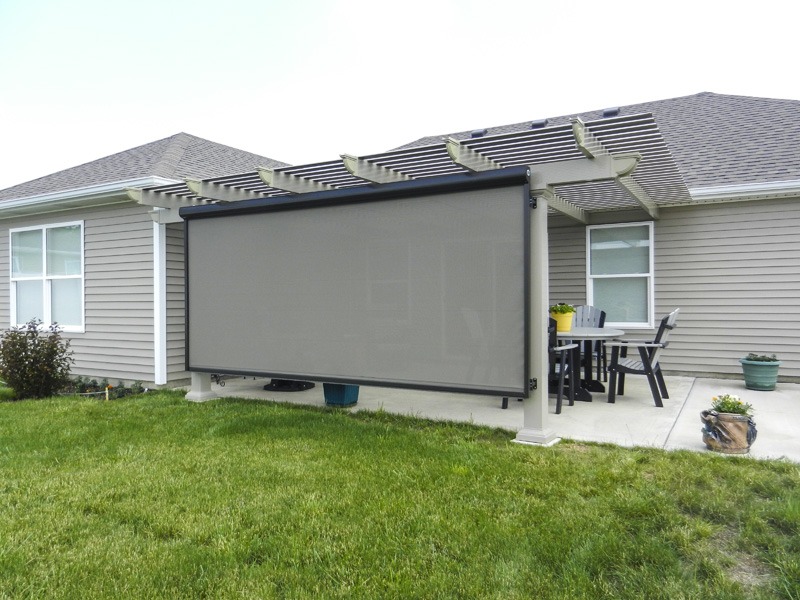
We'll tell you straight: a retractable awning is not always the right product for a porch. If your porch is already fully roofed and the only problem is low west sun cutting in under the overhang, you don't need a top awning at all. A Sentry motorized solar screen or a SmartDrop front-drop valance on the open west edge solves that for less money, and we'll steer you there. If you want a permanent, all-weather porch roof you can leave up through winter snow load and never touch, buy a fixed structure instead, because a retractable unit is meant to fold away and should not carry standing snow. And if your porch is a true bluff-edge site with sustained high wind rather than occasional gusts, the sensor will retract the awning so often you won't get much use from it, so a fixed louvered system may serve you better there. We would rather size the right product than close the wrong sale.
See the Sentry motorized solar screen for shading a fully roofed porch edge
Installed by Sunesta-Certified Installers, Not Subcontractors
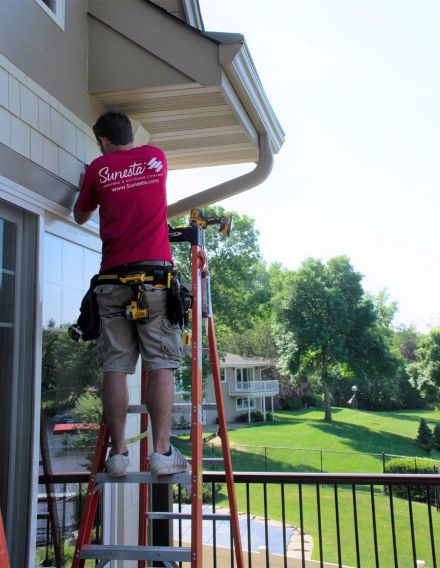
Every retractable porch awning we sell is installed by Sunesta-Certified Installers who are our own employees. We don't use subcontractors under any circumstances, so the crew on your porch knows the dual-cable arm system inside out. Lead time from order to installation runs four to six weeks, because each awning is custom-built to the inch in Jacksonville, Florida, then crated and shipped to us. The onsite technician walks you through operating and maintaining the awning before sign-off, and the workmanship is backed by a one-year installation warranty on top of Sunesta's factory coverage. We've been pioneering the retractable awning industry since 1981.
Frequently Asked Questions
Do porch awnings need structural attachment review in Kansas City?
Sometimes. A porch awning larger than 30 square feet mounted to a wood-frame second story in the City of Kansas City, MO requires a structural attachment review through KC Codes Administration before installation, and we won't skip that step. Smaller ground-level porch awnings on solid masonry or a properly backed band joist typically don't. On any covered porch we also confirm the existing porch roof framing can carry the added load at the anchor points before we quote. Requirements vary by jurisdiction across the metro, so the Johnson County city building departments handle the KS-side porches. We handle the review as part of the job.
How wide can a porch awning be without front posts?
Up to 40 feet. The Sunesta and Sunstyle models reach 40' wide, and the Sunlight reaches 24'. Projection extends up to 14'8" on the Sunesta with no front posts, because the dual-cable arm system carries the full width and projection off the house wall. Nothing touches the porch floor in front, so a wide porch span stays completely open underneath. Every awning is custom-made to the inch to fit your specific porch.
Front porch or back porch: which needs a bigger awning?
Usually the back porch. Front porches tend to be narrow and already roofed, so they take a shorter-projection awning off the fascia to shade the steps and entry from low west or east sun. Back porches are wider and more open, often stepping down to a deck, so they need a wider unit at deeper projection to cover a full seating area. Projection matters more than width on either one: a 16-foot awning at 11'6" of projection shades more usable porch floor than a 22-foot awning at 8'. We measure the shadow path at 4 p.m. on site before sizing anything.
What fabric holds up best on a shaded, humid KC porch?
Solution-dyed acrylic, the Sunbrella-grade material we use on every Sunesta awning, in over 130 colors. A covered porch traps humid air, and KC summers run near 95°F at about 70% humidity for weeks, so the fabric has to breathe and resist mildew. Solution-dyed acrylic does, and its color runs all the way through the fiber so it doesn't streak when oak catkins, sycamore tannins, and cicada cast wash off each spring. We never use vinyl-coated polyester on a KC porch, because it traps moisture against the weave and breaks down under the pollen load.
Related Services
- Retractable Porch Awnings for Kansas City Porches
- Sentry Solar Screens for the Open Porch Edge
- Retractable Patio Covers for Decks & Patios
- Porch Awning Fabrics
- Current Specials
- Get a Free Porch Awning Quote
- Browse All Sunesta of Kansas City Services
- Porch Awnings Across the KC Metro
- Retractable Porch Awnings in Overland Park, KS
- Retractable Porch Awnings in Lee's Summit, MO