
Retractable Patio Screen Enclosures for Kansas City
You've got an open deck or patio that's unusable by 4 p.m. when the west sun drops low, and the first real breeze fills it with pollen, mosquitos, and the neighbor's sightline. Enclosing the open sides with Sentry motorized solar screens fixes all three at once: the screens drop down to shade, buffer the wind, and close off the view, then roll up out of sight when you want the deck open to the sky again. We measure, fabricate, and install the Sentry across the open sides of patios and freestanding decks throughout the Kansas City metro, and every job is handled by our own Sunesta-Certified Installers. Call 913-355-1236 for a free on-site measure of your patio.
What Is a Retractable Screen Enclosure for a Patio?

A patio screen enclosure is a set of motorized vertical solar screens that close off the open sides of a deck or patio on demand, turning open-air space into a screened room you can still open back up whenever you want. Unlike a fixed screened box built with framed panels, the Sentry only comes down when you deploy it, so the patio reads as open when the screens are up and as an enclosed outdoor room when they're down. This is the same Sunesta Sentry motorized solar screen we install under decks, on windows, and on garages, configured to wrap the exposed sides of a patio. Sunesta pioneered retractable shade engineering back in 1981, and the Sentry brings that push-button control to a patio that was never framed to be screened in the first place.
How to Get a Screened In Patio Without Framing a Room
A screened in patio usually means a carpentry job: posts, headers, framed panels, and a fixed roof, a permanent structure you can't undo when you want open sky. The Sentry does it differently. Each screen mounts at the top of an opening between existing posts or along the edge of a patio cover and drops straight down to the deck, sealing at both edges without a single framed panel. You can screen one side for privacy, two sides against the prevailing wind, or wrap three sides for a fully enclosed feel, and every screen operates on its own. Widths run up to 18 feet per unit with drops up to 12 feet, so a typical patio bay is covered by a single screen and a wide run is split cleanly across two. The result is a screened in patio you deploy in seconds and retract just as fast, not a room you're stuck with in October.
- Enclose One Side or Three — Screen a single side for privacy, two sides against the prevailing southwest wind, or wrap three sides for a full enclosure. Each Sentry runs independently, so you drop only the sides you need on any given afternoon.
- Sealed at Both Edges — A captured edge rail and a welded fine-tooth zipper riding a floating track hold the fabric tight down both sides, so mosquitos, oak catkins, and sycamore debris stay outside the patio instead of drifting in around loose gaps.
- Rolls Up to Open Sky — When you want the deck open again, every screen retracts fully into its housing at the top of the opening. The patio looks exactly as it did before, and the fabric is protected from weather when it's not down.
Motorized Patio Screens: Push-Button Control, No Cranks

Every screen in the enclosure runs on a Somfy motor with a handheld RTS remote, so the whole patio closes up or opens back to the sky without you touching the fabric. There are no hand cranks and no heavy panels to lift into place. When the low 4 p.m. sun comes across a west-facing deck, you drop the west screen and keep the shade without losing the whole afternoon. When a spring evening turns buggy, you drop the rest. The solar screen fabric cuts the glare and heat coming through a wide-open exposure while still holding your view through the weave, which is the difference between a patio you abandon at mid-afternoon and one you actually sit on. Call 913-355-1236 to schedule a free on-site measure of your patio.
Add Motorized Screens to an Existing Patio Cover

If you already have a patio cover, an awning, or a solid roof over the deck, you're most of the way to an enclosure. The overhead structure gives us the top mounting line, and the Sentry screens drop from the front and sides to close in what's already shaded from above. Where the cover's framing calls for it, we fasten the screen housing and side rails to a 2x6 ceiling-joist nailer on 16-inch centers rather than into trim, so the units carry firm and seal true down the full drop. Pairing screens with an existing retractable patio cover is one of the cleanest upgrades we do: the cover handles the sun and light rain from above, the screens handle the wind, bugs, and low-angle sun from the sides, and the two systems work independently. This is where a shaded-but-exposed patio becomes an actual outdoor room.
A Screen Enclosure Patio Built for Kansas City Weather
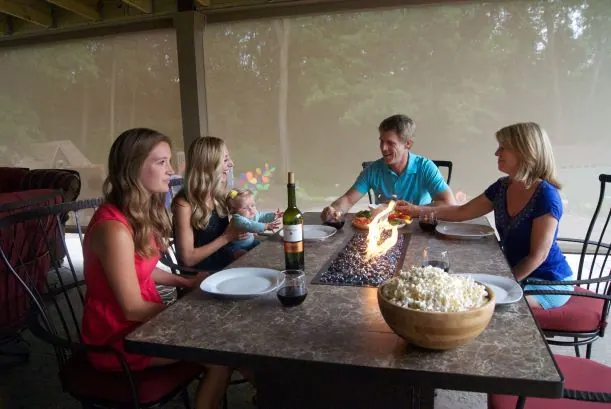
KC hands an open patio a specific list of problems, and a screen enclosure answers most of them. Summer highs sit near 95°F with humidity holding around 70% for weeks, and the deeper west-facing lots on the Missouri side in Lee's Summit, Blue Springs, and Raymore take the full 4 p.m. sun with nothing to stop it. A dropped solar screen on the west side buys back those late afternoons. In May, oak catkins and heavy pollen coat every open surface, sycamore tannins stain, and Brood XIX cicada cast piles up wherever it lands, and a sealed screen keeps that out of the space you actually use. The enclosure is a solar and wind screen, not a rigid structure, so when the 50-plus-mph spring gust fronts roll through, an optional automatic wind sensor retracts the screens before the wind can load the fabric. That sensor trips at 28 mph across most of the metro and at a lower 22 mph on bluff-edge sites above the Missouri River in Parkville, where gusts accelerate over the drop.
Does a Retractable Screen for a Patio Keep Bugs Out?

Yes, when it's sealed correctly on every side, and that's the part that separates the Sentry from a bargain kit. The captured edge rail and the welded zipper track hold the fabric tight against both edges of each opening, so there's no gap for mosquitos and wasps to slip through the way they do around loose panels hung on magnets or velcro. The floating track keeps that seal firm as each screen goes up and down. We'll be straight about the limits, though: the Sentry is a solar and wind screen first. On an enclosed patio it does an excellent job holding out the bugs and debris a KC deck attracts, but it is not a hermetic insect enclosure and it is not a structural wall. If you need a locked, weather-tight, four-season sunroom, that's a framed addition, not a screen enclosure, and we'll tell you so rather than sell you the wrong product.
When a Patio Screen Enclosure Is the Wrong Call

We'd rather lose the sale than sell you the wrong thing. If what you actually want is a conditioned, lockable, year-round sunroom, screens won't get you there and you should be pricing a framed addition instead. If your patio sits on a true bluff edge with sustained high wind rather than the occasional gust, the screens will spend more time retracted than down and you won't get much use out of them, so a fixed system may serve you better. And if you're chasing a solid roof over the deck rather than closing in the sides, that's a patio cover conversation, not a screen enclosure. The Sentry earns its keep for the patio that already has decent overhead shade or open sky and just needs the sides closed in against sun, wind, bugs, and the neighbor's view.
Fabric and Frame Colors to Match Your Home
The Sentry comes in a range of solution-dyed acrylic screen fabrics and multiple frame colors, so the screens and their housings blend into the deck line instead of forcing a mismatched white box onto a brick or Hardie exterior. Solution-dyed acrylic is the same Sunbrella-grade material we use across the awning line: it resists the fading KC's long sun hours cause and sheds the pollen and tannins that stain lesser fabrics. Different screen densities are available depending on whether you're prioritizing view-through, glare control, or a tighter weave against insects, and we'll walk you through which density fits which side of the patio during the in-home visit.
Installed by Sunesta-Certified Installers, Not Subcontractors
Every patio screen enclosure we sell is installed by Sunesta-Certified Installers who are our own employees, never subcontractors. On an existing patio we set each housing and its side rails to the actual opening, and where a patio-cover or porch ceiling detail calls for it, we fasten to a 2x6 ceiling-joist nailer on 16-inch centers rather than into trim. Mounting substrate matters: pre-1970 KC homes with 1x cedar fascia get through-bolted backing, brick veneer takes 3/8" wedge anchors into solid courses rather than mortar joints, and newer Johnson County stock in Overland Park and Olathe is typically engineered rim board or Hardie. Lead time from order to installation runs four to six weeks because each Sentry is custom-built to your patio. The technician walks you through operating every screen and the remote before sign-off.
Frequently Asked Questions
Can you screen in an existing patio?
Yes. That's most of what we do with the Sentry on patios. We mount each motorized solar screen at the top of an existing opening, between posts or along the edge of a patio cover, and it drops straight down to the deck to close in the side, no framing or carpentry required. You can screen one side, two, or wrap three for a full enclosure, and every screen retracts out of sight when you want the patio open again. Where the framing calls for it, we fasten to a 2x6 ceiling-joist nailer on 16-inch centers so the units carry firm and seal true down the full drop.
How much wind can a patio screen take?
The Sentry is a solar and wind screen, not a rigid wall, so instead of a fixed wind rating it uses an optional automatic wind sensor that retracts the screens before a gust can load the fabric. That sensor trips at 28 mph across most of the Kansas City metro, and at a lower 22 mph on bluff-edge sites above the Missouri River in Parkville, where gusts accelerate over the drop. That protects the fabric during the 50-plus-mph spring gust fronts KC sees. On a site with sustained high wind rather than occasional gusts, we'll tell you honestly whether a fixed system is the better call.
How wide can a patio screen enclosure be?
Each Sentry unit is available in widths up to 18 feet and drops up to 12 feet, custom-built to the inch. A typical patio bay is covered by a single screen, and a wider run is split cleanly across two or more units. For a full enclosure we measure every open side on-site and spec each screen to its actual opening so it seals at the edges, because a patio screen that doesn't seal isn't doing its job.
How much does a patio screen enclosure cost in Kansas City?
Price depends on how many sides you enclose, the width and drop of each screen, the fabric and frame color, and options like an automatic wind sensor, so we quote every enclosure after a free on-site measure rather than posting a single number. A single privacy screen and a full three-side enclosure sit at very different points. Ask about current specials and financing during the in-home visit. Call 913-355-1236 or request a free quote to get a firm figure for your patio.
Related Services
- Sentry Patio Screen Enclosures
- Add Motorized Screens to a Patio Cover
- Screen Fabrics
- Garage Door Screens
- Current Specials
- Quote a Patio Screen Enclosure
- Browse All Sunesta of Kansas City Services
- Patio Screen Enclosures in Kansas City, MO
- Patio Screen Enclosures in Lee's Summit, MO
- Patio Screen Enclosures in Overland Park, KS